How Fast Does Mold Grow After Water Damage? (48 Hours)
Mold needs three things: moisture, something organic to eat, and time. A wet house hands it all three. The short answer people come here for is about 48 hours, and that number is worth understanding, because almost every expensive mold job started as a small water loss somebody let sit over a weekend.
The 48-hour rule, and why it is not a guarantee
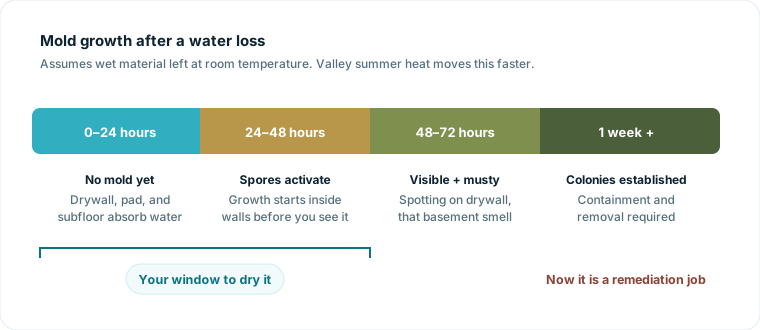
Forty-eight hours is the industry rule of thumb for when mold begins colonizing wet material. It is not a countdown timer, though, and in the Central Valley it often runs faster. Mold moves quicker when it is warm, and a closed-up house in a Stockton or Modesto July is effectively an incubator. A leak that starts Friday afternoon in August is a different animal from the same leak in February.
What actually drives the clock:
- Temperature. Growth accelerates in warm rooms. Valley summers push the fast end.
- What got wet. Paper-faced drywall, carpet pad, and particleboard are food. Tile and concrete are not.
- Airflow. Standing air in a closed room speeds it up. This is part of why crews set air movers immediately.
- Water category. Sewage and floodwater arrive already carrying contamination, so the clock effectively starts before the mold does.
Hours 0 to 24: the window that actually matters
Nothing is growing yet. This is the entire window you get, and it is why the first hour after finding water matters so much more than people expect.
In this stage the water is still moving: wicking up drywall, soaking through pad into subfloor, running along joists to places you would never guess. Extraction and drying started here usually mean no mold job at all. That is the whole ballgame.
Hours 24 to 48: it starts, out of sight
Spores that are present in every building all the time begin to activate on wet material. You cannot see anything yet. The surface of the drywall may even feel dry to your hand while the cavity behind it is saturated, which is exactly the trap. Surface-dry, core-wet is the most common reason homeowners think a leak resolved itself.
Hours 48 to 72: visible, and smellable
This is when people call. Dark spotting on drywall or trim, a musty basement smell in a house without a basement, or allergy symptoms that ease when you leave for the day. If you can smell it, there is enough of it to need real work.
One week and beyond: now it is a remediation job
Colonies establish, spread along the moisture path, and get into the cavity. At this point drying alone does not solve it. Killing mold without removing it and without fixing the water source just sets up a repeat, which is why bleach on a wall is not a fix.
Where mold actually hides
Almost none of the mold in a water loss is on the surface you are looking at. It is behind and beneath it.
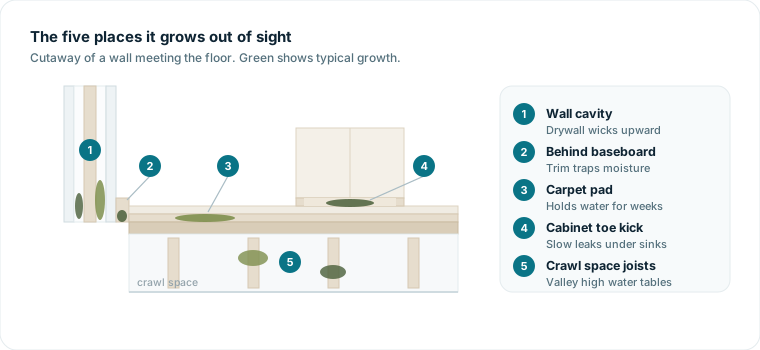
- Inside the wall cavity. Drywall wicks water upward well past the visible line. The back face grows first.
- Behind the baseboard. Trim traps moisture against the wall and slows evaporation exactly where the water pooled.
- In the carpet pad. Pad holds water for weeks. Carpet can feel dry on top while the pad underneath has not moved.
- Under the cabinet toe kick. Slow supply-line and disposal leaks run under the cabinet box, hidden from view for months.
- On crawl space joists and subfloor. High water tables across the 209 mean Valley crawl spaces collect moisture with no visible leak at all.
When bleach is fine, and when it is not
Honest version: for a few square feet of surface mold on a hard, non-porous surface, cleaning it yourself is reasonable. Tile, glass, sealed surfaces, a small patch around a shower.
You want a professional mold removal and remediation crew when:
- The affected area is larger than roughly 10 square feet
- It is on or behind porous material like drywall, pad, insulation, or wood
- The water source was sewage or outside floodwater
- Anyone in the house is immune-compromised, asthmatic, or elderly
- It keeps coming back, which always means the moisture source is still there
Bleach is a poor choice on porous material anyway. It is mostly water, so it wets the substrate while the surface stain disappears, which looks like success and is not.
What proper mold removal involves
Not spraying and wiping. A real remediation is a containment job:
- Containment and negative air. Plastic barriers and machines that keep pressure negative inside the work area, so spores do not spread through the rest of the house.
- HEPA filtration running throughout the work.
- Removal of affected porous material, because you cannot reliably clean mold out of drywall or pad.
- Treatment of remaining structure, then drying it to standard.
- Fixing the moisture source. Skip this and it comes back every time.
Does insurance cover mold?
Sometimes, and the deciding factor is usually the same one that decides the rest of the claim: whether the underlying water loss was sudden and covered. Mold that follows a burst pipe is often covered, frequently with a sublimit specific to mold. Mold that grew from a slow leak running for months usually reads as maintenance and gets denied. Many California policies cap mold coverage regardless of cause, so the number is worth checking on your declarations page before you need it. There is more detail in the guide on what homeowners insurance covers in California.
The practical takeaway: documentation from day one is what wins the argument, and that starts before mold ever appears.
The honest summary
Mold is a time problem, not a mystery. Water sitting for two days is a mold job; water extracted and dried in the first day usually is not. If something in your house got wet in the last 24 hours, the cheapest version of this story is still available to you, and it is the one where you dry it now.
If you are past that window and smelling something musty, dispatch answers 24/7 across San Joaquin and Stanislaus Counties.