How to Choose a Water Damage Restoration Company Near You
You are probably searching “water damage restoration near me” with water on the floor, which is the worst possible moment to evaluate a contractor. So here is the short version first: a good water damage restoration company answers live, shows up with a moisture meter, explains every cut with a reading, and hands you the documentation. Everything below is how to confirm that in about five minutes on the phone.
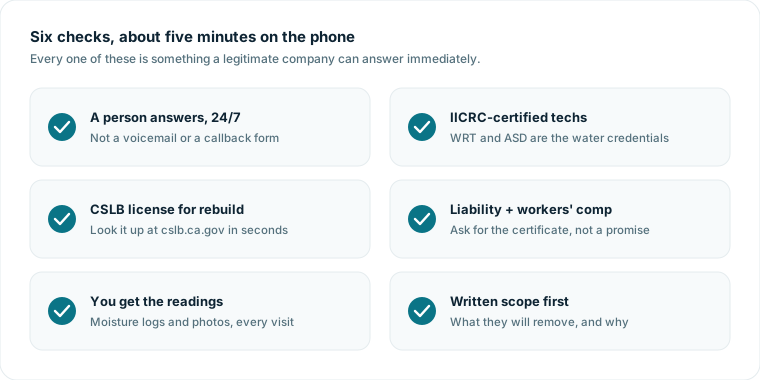
1. A real person answers, any hour
Water damage does not wait for business hours, and neither should the company. If you call at 11pm and get voicemail or a web form, keep going. The first few hours decide how much of your house gets saved, which is why the first hour after finding water matters so much. A company that cannot answer the phone tonight cannot start extraction tonight.
Ask: “How soon can someone be here?” A local crew in the 209 should be able to give you a window in hours, not days.
2. IICRC-certified technicians
The IICRC, the Institute of Inspection Cleaning and Restoration Certification, sets the industry standard for water damage work, known as S500. The certifications to listen for are WRT (Water Damage Restoration Technician) and ASD (Applied Structural Drying). They mean the tech was trained in how moisture moves through a building and how to prove it is gone.
Ask: “Will the lead tech on my job be IICRC certified?“
3. A California contractor license for the rebuild
Emergency drying is one thing. Rebuilding drywall, flooring, and cabinets is construction, and in California, work over $1,000 in labor and materials requires a license from the Contractors State License Board. You can look any license up by name or number at cslb.ca.gov in under a minute, and see whether it is active and bonded.
If the mitigation company hands the rebuild to someone else, check that company too. Our guide to mitigation vs restoration explains where that handoff usually happens.
4. Liability insurance and workers’ comp
A crew working in your house needs general liability coverage in case they damage something, and workers’ compensation in case someone gets hurt on your property. Ask for a certificate of insurance. Legitimate companies send one by email the same day without any fuss.
5. Moisture readings and photos you actually receive
This is the one that separates professionals from people with a van and some fans. Good restoration is measured: moisture readings on day one, daily readings after that, and photos of everything removed. That documentation is what your adjuster needs to approve the claim, and it is what proves the house was dried properly.
Ask: “Will I get copies of the moisture logs and photos?” The answer should be an immediate yes.
6. A written scope before the demolition starts
In an emergency, extraction starts right away and that is fine. But before drywall and cabinets start coming out, you should know what is being removed and why. A good crew points to the meter reading that justifies each cut.
Red flags that mean slow down
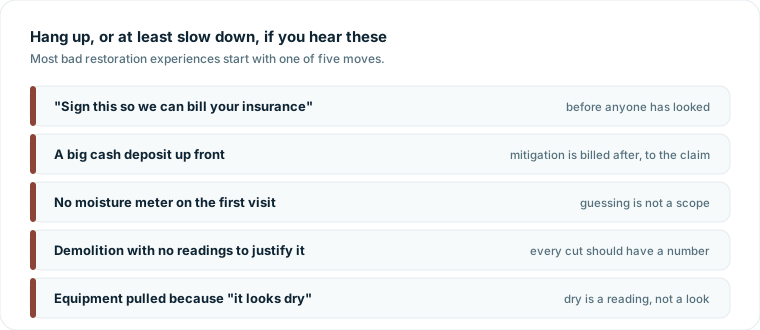
- Pressure to sign an assignment of benefits before anyone has inspected. An AOB hands your insurance claim rights to the contractor. It is not automatically a scam, but never sign one you have not read, under pressure, at the door.
- A large cash deposit up front. Mitigation is normally billed afterward, often directly to the insurance claim.
- No moisture meter or thermal camera on the first visit. Without readings, nobody knows where the water went.
- Tearing out material with no readings to justify it. Over-demolition inflates the bill and the rebuild.
- Pulling the equipment because it “looks dry.” Surfaces dry days before wall cavities do. Dry is a number, not a look.
Questions to ask on the first call
Keep this list handy. A legitimate company answers every one without hesitating:
- How soon can a crew be here?
- Are your technicians IICRC certified?
- What is your CSLB license number?
- Can you email a certificate of insurance?
- Will I get the moisture logs and photos?
- Do you work directly with my insurance company?
- Who does the rebuild, you or a partner?
Does your insurance company pick the contractor?
No. Your insurer may suggest a preferred vendor, and sometimes that is a perfectly good option, but you decide who works on your home. What matters to the insurer is that mitigation starts promptly and is documented well. The California insurance guide covers what is typically covered and what gets denied, and our dispatchers can help with insurance claim paperwork.
What “near me” should actually mean
Local matters in water damage for a practical reason: response time. A crew based in Stockton, Modesto, or Manteca can have extraction running while a crew from the Bay Area is still on the Altamont. Local crews also know the area’s quirks, like high water tables in Delta neighborhoods, slab leaks in hard-water tracts, and crawl spaces that flood with no visible leak.
What to expect if you call us
209 Restoration is a 24/7 dispatch line for water damage across San Joaquin and Stanislaus Counties. A live dispatcher answers, and a licensed, insured local crew gets sent for emergency water removal, structural drying, and the rest. Run the checklist above on whoever shows up. We would rather you do.